The Permit Before the Pits: Why Water Risk Now Sets the Timetable for UK Mining
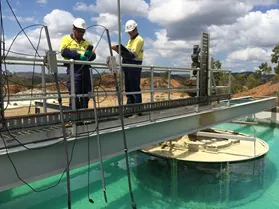
Photo: Unknown authorUnknown author, CC BY 4.0, via Wikimedia Commons
Ask a UK mining board what keeps it awake and the answer will usually involve carbon, capital or commodity price. Ask what actually delays projects and the answer is more often a river.
Water risk has been treated as a sustainability annexe — a line in the environmental statement, a commitment in the community plan. In 2026, after successive dry years and a measurable tightening of regulatory practice, it belongs on the critical path. Abstraction licences are being reviewed with more scepticism, discharge conditions are being written more tightly, and the precedent of water neutrality has shown how a single catchment concern can freeze development consent indefinitely.
Three permissions, one clock
A UK extraction project rarely depends on a single water consent. It depends on an interlocking set.
An abstraction licence governs how much water may be taken and when, under what hands-off flow conditions and for how long. Environmental permits govern discharge to surface water or groundwater, and the monitoring that goes with it. Planning permission carries conditions, habitat regulations assessments and, increasingly, catchment-level obligations. Layered on top are the commercial arrangements: a supply agreement with a water company whose own resource plan may not have anticipated an industrial user of that scale, and drainage consents from internal drainage boards where relevant.
Each has its own determination period, its own appeal route and its own capacity to hold up the others. A board that plans for the shortest of these is planning for the least likely outcome.
Baseline data cannot be bought late
Regulators decide water cases on evidence, and evidence takes time. A credible application typically rests on at least twelve to twenty-four months of site monitoring: low-flow statistics, groundwater level series, surface water chemistry, and an ecological assessment of any groundwater-dependent habitat that might be affected.
This is where boards most often misjudge cost. The expense of monitoring is trivial against the expense of delay. A project entering determination with a thin baseline finds its permit loaded with conditions, its application returned for further information, or its planning committee advised to defer. None of those outcomes is recoverable by spending money in the final quarter.
The practical implication is straightforward: commission hydrological and hydrogeological work at the same moment as resource definition, not after it. Where a site sits in a catchment already flagged as stressed, add a year.
The stakeholder map extends well beyond the fence
Water is a shared resource, and the objectors to an abstraction licence are rarely the people who objected at planning. They are neighbouring farmers whose own licences may be reviewed alongside yours, angling clubs and rivers trusts with long institutional memory, internal drainage boards, parish councils and, on occasion, the water company itself.
The most consequential relationships are often with other abstractors in the same catchment, whose support or opposition shapes how the regulator balances competing demands. Early, documented engagement — a published water balance, a catchment partnership contribution, a clear position on drought-year behaviour — does more for a determination than any amount of late-stage consultation.
National parks and protected landscapes add a further layer. A site within or adjacent to a designated area can expect scrutiny not only of its water use but of its visual and hydrological footprint together.
The precedent that changed planning
The most instructive UK case remains water neutrality in the Sussex North supply area, where advice on nutrient and water impacts effectively halted new development until neutrality could be demonstrated. Whatever one thinks of the merits, the lesson for extractive developers is durable: where a catchment is failing, the burden shifts onto the applicant to prove that its scheme will not add to the problem — and proving a negative is slow.
Similar dynamics have played out through nutrient neutrality in the Solent, the Wye and the Broads. Each demonstrates how an ecological constraint, once established, becomes a de facto planning moratorium with a multi-year timeline.
Disclosure and the cost of capital
Lenders and insurers now ask water questions that would have seemed exotic five years ago: site-level water balance, catchment stress classification, drought contingency, discharge quality trends and the sensitivity of the operation to a restricted licence.
Nature-related disclosure frameworks are being adopted by listed groups and their financiers, and water typically features among the first metrics reported. For a junior developer, the practical audience is narrower but no less demanding: the technical adviser conducting due diligence on behalf of a prospective funder, who will read the environmental statement and the permit conditions before reading anything else.
There is also reputational arithmetic. A drought-year headline about an industrial user taking water from a stressed river does more damage to a social licence than most emissions disclosures.
A board-level checklist
- Does the project have at least two years of site-specific hydrological baseline, and is it to regulatory standard?
- Has the catchment been classified for stress, and is the abstraction licence time-limited or under review?
- Has the water company confirmed that its resource plan can serve the site at the required volume?
- Have neighbouring abstractors been mapped and engaged before submission?
- Is the discharge route agreed in principle, with chemistry modelling and monitoring design in place?
- Does the financial model carry realistic determination periods and a contingency for further information requests?
- Are water metrics included in management reporting, with a named executive owner?
- Is there a drought protocol that the regulator, the community and the lender have all seen?
The discipline of getting it right
Water risk is not a reputational nicety to be addressed once planning is secured. It is a permitting question that determines sequencing, capital efficiency and, in stressed catchments, whether a project proceeds at all. The boards that treat hydrology as early-stage technical work — funded alongside drilling, reported alongside grade — will find the path to consent considerably shorter than those that treat it as paperwork. In a changing climate and a stricter regulatory climate, the permit comes before the pit.