Freight Paths and Freeholds: Rethinking Quarry Value Through the Rail Envelope
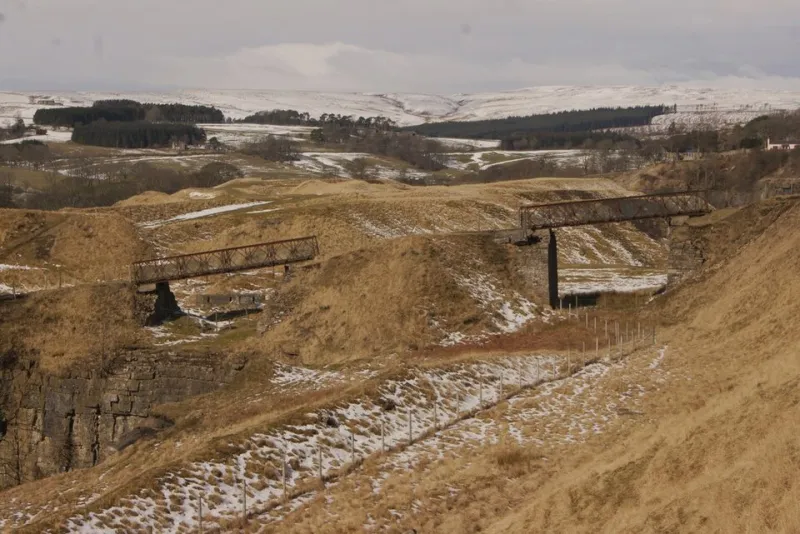
Photo: D M Wilmot , CC BY-SA 2.0, via Wikimedia Commons
UK quarry valuation has traditionally begun with geology: reserve tonnage, quality, planning permission and restoration liability. That remains necessary. It is no longer sufficient. In 2026, the scarcity that separates a profitable aggregate site from a stranded one is increasingly logistical. Rail connectivity — the physical siding, the timetable path and the last-mile road link — is becoming the binding constraint on which quarries can reach high-value construction markets at acceptable cost and carbon intensity.
From reserve statement to route-to-market
A mineral reserve is a stock. A quarry business is a flow. The difference is the route to market. For high-value construction demand, particularly in London and the South East, the winning sites are not always those with the largest permitted reserves. They are the ones that can place consistent tonnages into those markets without relying entirely on road haulage. Rail-connected quarries enjoy a structural advantage: lower marginal transport cost over distance, greater load consolidation and a more defensible carbon profile. But that advantage is not automatic. It rests on a chain of assets and permissions that must be tested individually.
The commercial test is not whether a site has ever dispatched by rail. It is whether the site can do so repeatedly, within permitted hours, at a cost that survives a carbon-adjusted contract. That distinction matters to operators and investors alike.
The three bottlenecks: siding, path and last mile
Rail connectivity is often described as a single attribute. In practice, it comprises three bottlenecks.
The first is siding capacity. A quarry may have a rail connection, but if the siding is too short for modern freight formations, lacks adequate loading and storage space, or cannot turn wagons efficiently, its practical throughput is limited. Wagon supply and freight operating company arrangements also matter. A siding without a viable operating agreement is an asset in waiting.
The second is the timetable path. Freight paths are allocated within a national network that must also accommodate passenger services, engineering possessions and competing freight demand. A path that exists in theory may not be available at the times a quarry needs to load, or may be vulnerable to future timetable changes. A quarry without a durable path is a quarry with an option, not a connection.
The third is the last mile. The road link between the quarry and the railhead can be the weakest part of the chain. Weight restrictions, village amenity, school run congestion, clean air zones and HGV driver availability can all erode the economics of rail. The carbon advantage of rail is also partly offset if the last mile is long or inefficient.
Haulage arithmetic and carbon reporting
Road haulage remains flexible and, for shorter distances, often competitive. The rail case strengthens with distance and volume. But the break-even point is site-specific. It depends on road rates, rail terminal charges, wagon hire, loading costs, backhaul opportunities and the reliability of paths. Operators should model rail on a fully costed basis, not on a headline rate per tonne.
Carbon reporting is now part of the same calculation. Public procurement, building standards and corporate supply chains increasingly require carbon data for construction materials. A quarry that can demonstrate a lower transport carbon intensity may find it easier to win contracts and to defend price. That is not a reason to overstate the benefit of rail. It is a reason to measure the whole route, including the last mile, and to present the result transparently.
Planning and consent risk
Rail enhancements at quarries attract planning and environmental scrutiny. Noise, dust, operating hours, lighting, road traffic and ecological impacts all need to be addressed. The relevant consenting route depends on the scale and nature of the works, and on whether the site benefits from existing permissions. Investors should not assume that a historic rail connection can be reactivated without conditions. Nor should they assume that a new siding will be consented at the pace the commercial plan requires.
The practical diligence question is whether the logistics envelope is permitted, not merely engineered. A siding that can only operate during hours that do not match market demand is a constrained asset. A railhead that depends on a road network unsuitable for regular HGV traffic is a contingent asset.
A diligence checklist for operators and investors
- Confirm ownership or secure tenure of the siding, railhead and associated land, including any lease terms that could expire before the reserve is worked out.
- Commission a capacity assessment covering siding length, loading arrangements, storage, turnaround times and wagon compatibility.
- Establish the basis of access to the network: path availability, operating agreements, terminal arrangements and any dependency on a third-party freight operator.
- Test the last-mile road route for weight limits, HGV routing, curfews, congestion and community sensitivity.
- Review planning and environmental consents for rail operations, including noise, dust, hours and lighting conditions.
- Model haulage and rail economics across a range of distances, volumes and carbon prices, with sensitivity to path reliability.
- Assess capital and maintenance obligations for sidings, loading equipment and any required network enhancements.
- Compare the site against alternative supply points on a route-to-market basis, not only on reserve quality.
The valuation implication
A useful framework is to classify sites as rail-connected, rail-connectable or rail-isolated. Connected sites have an operating chain today. Connectable sites have a credible path to one, subject to capital, consent and timetable risk. Isolated sites may still be valuable for local markets, but they should not be valued as if they can reach distant high-value demand.
That classification should feed directly into valuation. The logistics envelope affects achievable sales volumes, realised prices, operating costs and carbon intensity. It also affects the discount rate a buyer should apply to reserves that may never be economically transported. A large reserve behind a weak logistics chain is not a guarantee of value. It is a test of whether the route-to-market can be made to work.
For UK quarry operators and their investors, rail connectivity is no longer a peripheral infrastructure question. It is a core determinant of market access. The sites that will matter in 2026 and beyond are those that can combine permitted reserves with a durable, consented and cost-effective rail envelope. Siding, path and last mile deserve the same scrutiny as geology.