The Salvage Ledger: Separating Cost from Recoverable Value in UK Onshore Decommissioning
The UK onshore oil and gas estate is old, dispersed and increasingly expensive to retire. Fields that once carried modest but reliable production are now moving through the long tail of decline, and the boardroom conversation is shifting from how much hydrocarbon remains to who pays for the wellhead, the tank farm and the restoration obligation. That conversation is necessary, but it is incomplete. Decommissioning is not only an exit cost. It is also a small, messy and genuinely British resource business, with salvage steel, specialist water treatment, site reuse and land restoration sitting alongside the plugging bill.
Two ledgers, not one
The first mistake in any decommissioning review is to net gross salvage estimates against gross plugging costs and call the result a liability. That arithmetic flatters the downside and obscures the work required to capture value. A more disciplined approach uses two ledgers. The liability ledger records what cannot be avoided: well plugging and abandonment, facility removal, waste disposal, soil and groundwater remediation, permitting, and the monitoring that follows. The resource ledger records what might be recovered: ferrous and non-ferrous scrap, reusable plant and pipework, specialist produced-water treatment capacity, restored land with a defensible after-use, and the regional supply chain that grows around retirement work.
The two ledgers must be risk-adjusted separately. A tonne of scrap steel is not worth its headline price if it is contaminated, stranded or subject to unclear title. A restored site is not worth its residential comparables if the planning authority will only accept a lower-value after-use. The boardroom test is not whether value exists, but whether it can be captured within the permit, the timetable and the counterparty’s balance sheet.
The anatomy of onshore liability
Onshore decommissioning differs from its offshore cousin in scale and texture. Wells are smaller, but they are often older and poorly documented. A single site may have multiple vintages of wellhead, several generations of flowline, bunded tanks, produced-water handling and a planning permission whose restoration conditions were written for a different era. Legacy cement behind casing, unclear completion records and changes of operator over decades all push plugging costs upward. The Environment Agency’s permitting regime, minerals planning authorities and the North Sea Transition Authority’s licensing role each impose separate conditions, and the slowest consent often sets the timetable.
The liability is also socialised in ways investors should not ignore. Where an operator cannot fund its obligations, the risk of orphaned sites falls back on the public purse and on landowners who thought they had a straightforward lease. Decommissioning security, whether through bonds, letters of credit or parent-company guarantees, is therefore not a technical annex. It is a credit judgement on the operator and, increasingly, on the wider corporate group.
Where value hides
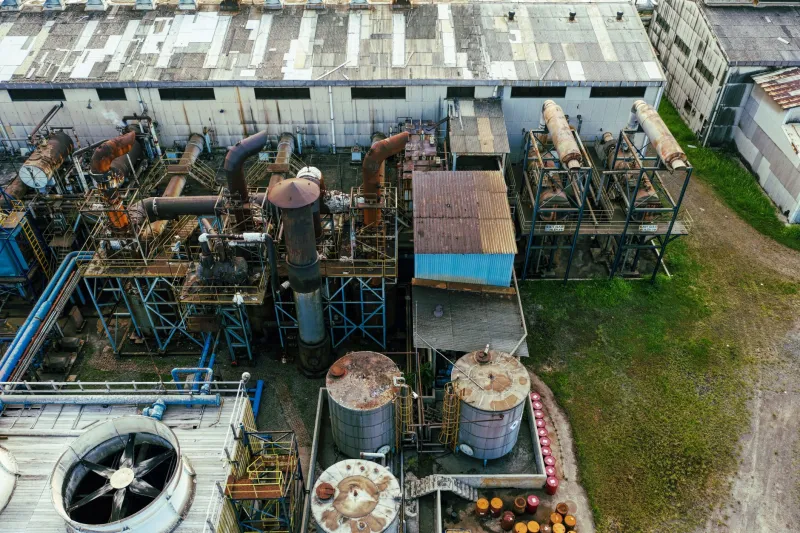
Salvage is the most visible source of recoverable value, but it is rarely straightforward. Onshore sites yield steel from tanks, pipework, wellheads and structural steelwork, plus copper and other non-ferrous fractions. Much of it is low-grade, contaminated or difficult to access without demolition that triggers waste classification and transport rules. The value is real, but it belongs to the contractor who can take the material legally and economically, not to the operator who simply owns the site.
Water treatment is a more interesting and less discussed opportunity. Produced water, displaced formation water and contaminated surface water must be handled long after production ends. Mobile treatment units, filtration, separation and specialist disposal routes are already a niche UK service sector. Operators that own treatment capacity, or that can contract it at scale across a cluster of nearby sites, have an advantage that does not appear in a conventional decommissioning estimate. The same applies to well-service crews, coiled tubing, workover rigs and demolition specialists: the regional supply chain is itself an asset, and it becomes more valuable as the estate retires.
Site reuse is the most contingent value of all. Former oil and gas sites can appeal to logistics, light industrial, solar or battery storage uses, but contamination, access, planning restrictions and local opposition all compress the upside. Restoration to agriculture or habitat is often the realistic outcome, and biodiversity net gain can create a measurable credit where the planning system allows it. The boardroom should treat reuse value as an option, not a certainty, and price it accordingly.
Diligence questions for three parties
For operators, the first question is whether the plugging and abandonment estimate has been independently audited, well by well, with a clear assumption on legacy well integrity. The second is whether waste routes and permits are contracted or merely assumed. The third is whether decommissioning security is adequate for the worst-case timetable, not the best case. Operators should also ask who owns the scrap and who carries the waste duty of care.
For landowners, the questions are about access, indemnities and restoration. Does the lease give the operator a right to remain for monitoring after restoration? Who pays if the operator fails? Is there a bond or guarantee that survives a change of control? What evidence exists that the site condition has been baselined, so that contamination is not discovered after the final payment?
For investors, the central issue is whether the liability is funded by a counterparty that can actually pay. A discounted provision on a marginal operator’s balance sheet is not the same as cash in escrow. Investors should also test salvage title, planning reuse assumptions and the realism of the after-use value. A decommissioning asset is only investable where the liability is bounded and the resource value is separately verifiable.
The valuation trap
The temptation is to describe a plug-and-abandon premium, as if retirement were a hidden profit centre. It is not. A premium exists only where recoverable value exceeds the risk-adjusted cost of capture, and in most onshore portfolios the liability still dominates. The useful discipline is to present both ledgers to the board, with explicit assumptions, and to resist the consolidation that makes a difficult obligation look like a balanced trade.
UK onshore decommissioning is a resource business hiding in plain sight. It will not rescue a weak operator, but it can improve the economics of an orderly retirement and create a durable regional supply chain. The boardroom that separates the unavoidable from the recoverable will make better decisions than the one that treats the whole estate as a single line of cost.